Bitcoin implied volatility drops to 7 month low despite macro risks
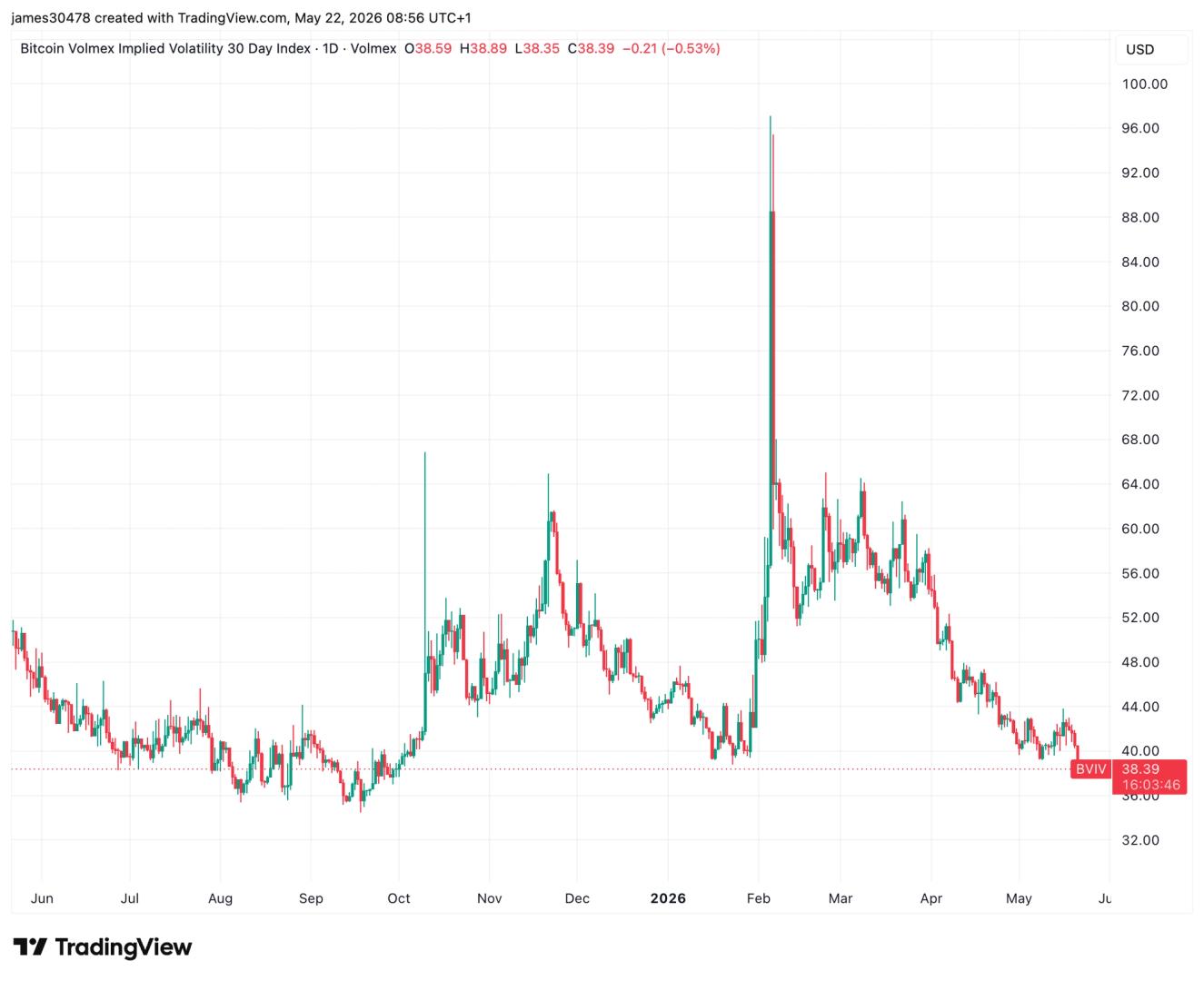
Analysis
Price Impact
LowThe drop in implied volatility suggests traders expect smaller price swings, indicating a lack of strong conviction for immediate large moves. despite macro risks mentioned, the market appears to be pricing them out or viewing them as less impactful on bitcoin's price in the short term.
Trustworthiness
HighPrice Direction
NeutralWhile lower volatility generally doesn't dictate direction, the current factors (easing geopolitical tensions, institutional demand, options selling) suggest a stabilization rather than a strong push in either direction. the market is currently calm, not indicating a strong bullish or bearish sentiment.
Time Effect
ShortImplied volatility is a forward-looking metric. a 7-month low suggests expectations for the immediate future (short-term) are for reduced price action. longer-term effects are less certain and depend on how macro risks evolve.
Original Article:
Article Content:
Markets Share Share this article Copy link X icon X (Twitter) LinkedIn Facebook Email Bitcoin implied volatility drops to 7 month low despite macro risks BTC's implied volatility is a picture of calm even as financial headlines warn of macro risks. By James Van Straten | Edited by Omkar Godbole May 22, 2026, 8:24 a.m. 2 min read Make preferred on BVIV (TradingView) What to know : Bitcoin implied volatility has fallen to a seven-month low as easing geopolitical tensions, heavy institutional demand led by Strategy (MSTR), and aggressive options selling by systematic yield strategies suppress market expectations for large price swings. Bitcoin’s declining volatility reflects its growing maturity as an institutional asset, with deeper liquidity, broader ownership, and increased adoption across ETFs, corporates, and asset managers helping stabilize the market over time. Financial headlines continue to warn of macro risks , yet bitcoin's BTC $ 77,341.59 volatility metric seems to think it's all noise. The cryptocurrency's annualized 30-day implied volatility index, BVIV, continues to slide, hitting 38%, its lowest reading since October 2025, according to data source Volmex. When implied volatility falls, it signals that traders expect calmer price action and fewer large moves ahead. “Bitcoin volatility has collapsed, and you can see it clearly in the BVIV levels, which we track closely to monitor market complacency,” said Shiliang Tang, Managing Partner at Monarq Asset Management. “First, the geopolitical risk from the Iran conflict is finally moving into the later stages. Second, the continued BTC buying from Strategy (MSTR) and its perpetual preferred STRC complex is dampening downside BTC volatility by acting as a structural floor," Tang added. He also blamed systematic "call overwriters" for driving the yield lower. Overwriting involves selling a higher strike out-of-the-money call option to earn an additional yield on top of the spot market holding. BTC is currently trading near $77,300, so anyone holding BTC and selling calls above that price is a call overwriter. Systematic overwriters, typically institutional funds running yield-enhancement strategies, continuously sell bitcoin options to collect premium income. This steady supply of options suppresses implied volatility and dampens expectations for large price swings. "Finally, because Bitcoin has underperformed other risk assets to the upside, systematic overwriters are aggressively selling options for yield, keeping a heavy lid on the entire volatility complex," Tang noted. Bitcoin is currently trading around $77,000, while oil markets, often used as a proxy for geopolitical risk, remain relatively contained, with WTI crude trading below $100 per barrel. Meanwhile, Strategy has purchased 171,238 BTC in 2026, significantly outpacing the roughly 63,450 BTC mined during the same period. That imbalance reinforces persistent institutional demand and reduces market supply. Bitcoin’s declining volatility also reflects its maturation as an institutional asset. As adoption expands across ETFs, asset managers, corporates, and treasury allocators, liquidity deepens, and ownership becomes more diversified, naturally reducing the extreme volatility that characterized bitcoin’s earlier years. Bitcoin News Volatility More For You XRP ETFs attract inflows amid wallet surge. bitcoin, ether funds struggle. By Sam Reynolds | Edited by Omkar Godbole 1 hour ago Fresh inflows into XRP-linked funds and a spike in newly created wallets suggest some traders may be rotating into the token while trimming exposure to crypto’s largest assets. What to know : XRP held near $1.37, with data suggesting some investors may be rotating into XRP. XRP-linked investment products have attracted about $42 million in net inflows over the past week, even as U.S. spot bitcoin ETFs shed more than $1.4 billion and ether funds also lost assets. On-chain data show a... Read full story Latest Crypto News XRP ETFs attract inflows amid wallet surge. bitcoin, ether funds struggle. 1 hour ago Bitcoin trades near $77,700 as analysts eye $75,000 support after liquidation wave 2 hours ago India cracks down on prediction markets: Polymarket goes dark, Kalshi could be next 3 hours ago Satoshi’s 1.1 million bitcoin and millions more can be saved from quantum attack, says expert 13 hours ago Mark Cuban says he sold most of his Bitcoin after failed hedge narrative 'disappointed' the billionaire 14 hours ago Ethereum’s identity crisis is deepening after high-profile 'brain drain' frustrates the community 15 hours ago Top Stories Live markets: Yet another Iran peace deal and Mark Cuban sells his bitcoin 18 hours ago U.S. CFTC secures deal with National Hockey League on prediction market safeguards 17 hours ago Blockchain.com files with SEC for U.S. IPO 18 hours ago The $6 billion expiration countdown: Traders pile into $82,000 bitcoin calls ahead of May 29 expiry 21 hours ago Binance launches SpaceX pre-IPO perps amid $2 trillion valuation bets May 21, 2026 Bitcoin's long-term holder supply approaches record high, breaking multi-year downtrend 19 hours ago In this article BTC BTC $ 77,341.59 ◢ 0.61 %