The metaverse isn't a place: Why Animoca’s Yat Siu says the future is 100 billion AI agents
Analysis
Price Impact
Trustworthiness
Price Direction
Time Effect
Original Article:
Article Content:
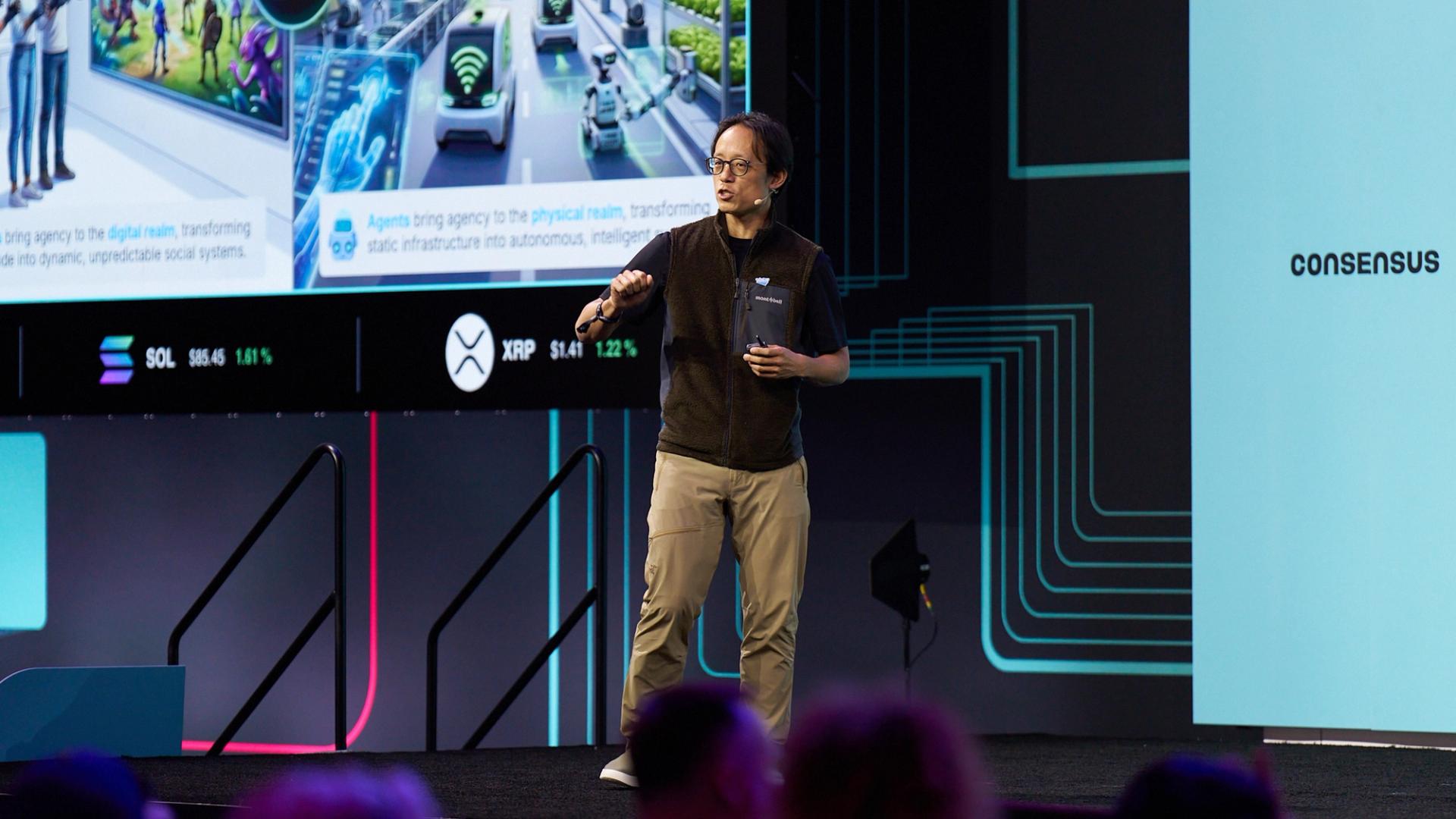
Markets Share Share this article Copy link X icon X (Twitter) LinkedIn Facebook Email The metaverse isn't a place: Why Animoca’s Yat Siu says the future is 100 billion AI agents Yat Siu said the metaverse is evolving beyond immersive digital worlds, with AI agents increasingly handling commerce, payments and coordination through blockchain infrastructure in the background. By Sam Reynolds | Edited by Jamie Crawley May 7, 2026, 9:09 a.m. 2 min read Make preferred on Animoca Brands' Yat Siu speaks at Consensus 2026 in Miami (CoinDesk) What to know : Animoca Brands chairman Yat Siu argued that the metaverse’s next phase will be driven by fleets of AI agents transacting on blockchains rather than humans in immersive virtual worlds. Siu predicted tens of billions of autonomous AI agents will handle bookings, payments, and online transactions in the background, using blockchain as their financial and identity infrastructure. He said this “agent economy” could solve crypto’s user-onboarding problem and announced a $10 million Animoca Minds initiative to fund developers building AI agent applications. The crypto industry may have fundamentally misunderstood the metaverse, according to Animoca Brands chairman Yat Siu, who argues that the next phase of virtual economies would arrive not through VR headsets or immersive digital worlds, but through fleets of AI agents transacting across blockchain networks behind the scenes. Siu said the metaverse maybe coming to us rather than being a place that humans go to, during his keynote at Consensus Miami 2026 . For Animoca, this marked a distinct pivot from the pandemic-era vision of the metaverse it once championed, in which users were expected to spend increasing amounts of their social and economic lives in immersive virtual worlds. Siu now says the more consequential shift may be AI systems operating in the physical world on behalf of humans, handling transactions, bookings, coordination and commerce in the background while blockchain networks function as the infrastructure connecting those agents. Instead, Siu argued the next phase of the internet may revolve around AI systems operating continuously in the background of everyday life, handling tasks such as bookings, payments, scheduling, and online transactions on behalf of users. He said consumers could eventually rely on dozens, or even hundreds, of AI agents to coordinate their digital activities, with blockchain networks serving as the financial and identity infrastructure connecting those systems. “I think the point is that it’s going to be more agents than humans,” Siu said, predicting there could eventually be “50 to 100 billion agents roaming essentially on the internet.” That shift, he argued, could also solve one of crypto’s longest-running problems: onboarding ordinary users. While an estimated 700 million to 800 million people globally now own some form of cryptocurrency, Siu noted that fewer than 70 million actively use blockchain applications because crypto remains technically intimidating for mainstream consumers. “My mom’s not going to be using MetaMask,” he said. “It’s hard for her.” AI agents, however, may interact naturally with wallets, smart contracts, and decentralized finance systems because they operate directly through code, he argued. Unlike humans, agents would not need traditional banking infrastructure and could transact autonomously on-chain. “Blockchain technology is the ideal financial system for machines,” Siu said. “We, the humans, were basically the guinea pigs.” The broader argument reflected a growing narrative within parts of the crypto industry that blockchain’s most scalable users may ultimately be autonomous software agents rather than humans. In that framework, wallets, tokens, decentralized identity systems, and on-chain payments become machine infrastructure powering an emerging “agent economy.” As part of that push, Animoca announced a $10 million investment initiative for developers building AI agent applications through its Animoca Minds platform. If Siu’s vision materializes, the next major wave of blockchain adoption may not come from millions of new human users learning to navigate crypto wallets, but from billions of AI agents transacting autonomously with one another behind the scenes. Consensus Miami 2026 Metaverse More For You Bitcoin lenders say institutions want crypto credit to look more like TradFi By Sam Reynolds , AI Boost | Edited by Shaurya Malwa 2 hours ago At Consensus 2026 in Miami, executives from Two Prime, Ledn and Lygos Finance said institutional borrowers increasingly prioritize custody, transparency and standardized lending structures over complex DeFi products after the crypto credit collapses of 2022. What to know : Institutional bitcoin lenders are shifting away from complex DeFi structures toward more traditional finance-style practices emphasizing transparency, standardized contracts and clear risk controls. Panelists at Consensus 2026 said institutional borrowers increasingly scrutinize where bitcoin collateral is stored and whether lenders rehypothecate assets, reflecting lessons from the 2022 crypto lending collapses. Read full story Latest Crypto News Bitcoin lenders say institutions want crypto credit to look more like TradFi 2 hours ago Trump family-backed American Bitcoin's costs dropped 23% in Q1 as mining industry pivots to AI 2 hours ago Three signals pointing to a possible bitcoin move to $85,000 3 hours ago BNY, world's largest custody bank, expands crypto services in Abu Dhabi 3 hours ago Ripple, JPMorgan settle first cross-border tokenized Treasury redemption on XRP Ledger 4 hours ago Dogecoin slides 4%, bitcoin rally pauses as Iran ceasefire optimism lifts equities 4 hours ago Top Stories White House targets July 4 for Clarity Act passage, says crypto adviser Patrick Witt 11 hours ago Eric Trump takes shot at JPMorgan rethinking bitcoin after 'crapping' on asset 15 hours ago U.S. Bitcoin Reserve update coming in 'next few weeks," White House adviser says 11 hours ago Bitcoin moves above $82,000 while ZEC and DASH post double-digit rallies 22 hours ago Morgan Stanley brings crypto trading with lower fees than rivals 20 hours ago Consensus Miami Day 2: Real-time coverage and highlights from on the ground 18 hours ago