Bitcoin passes halfway point in halving cycle as price gains trail prior cycles
Analysis
Price Impact
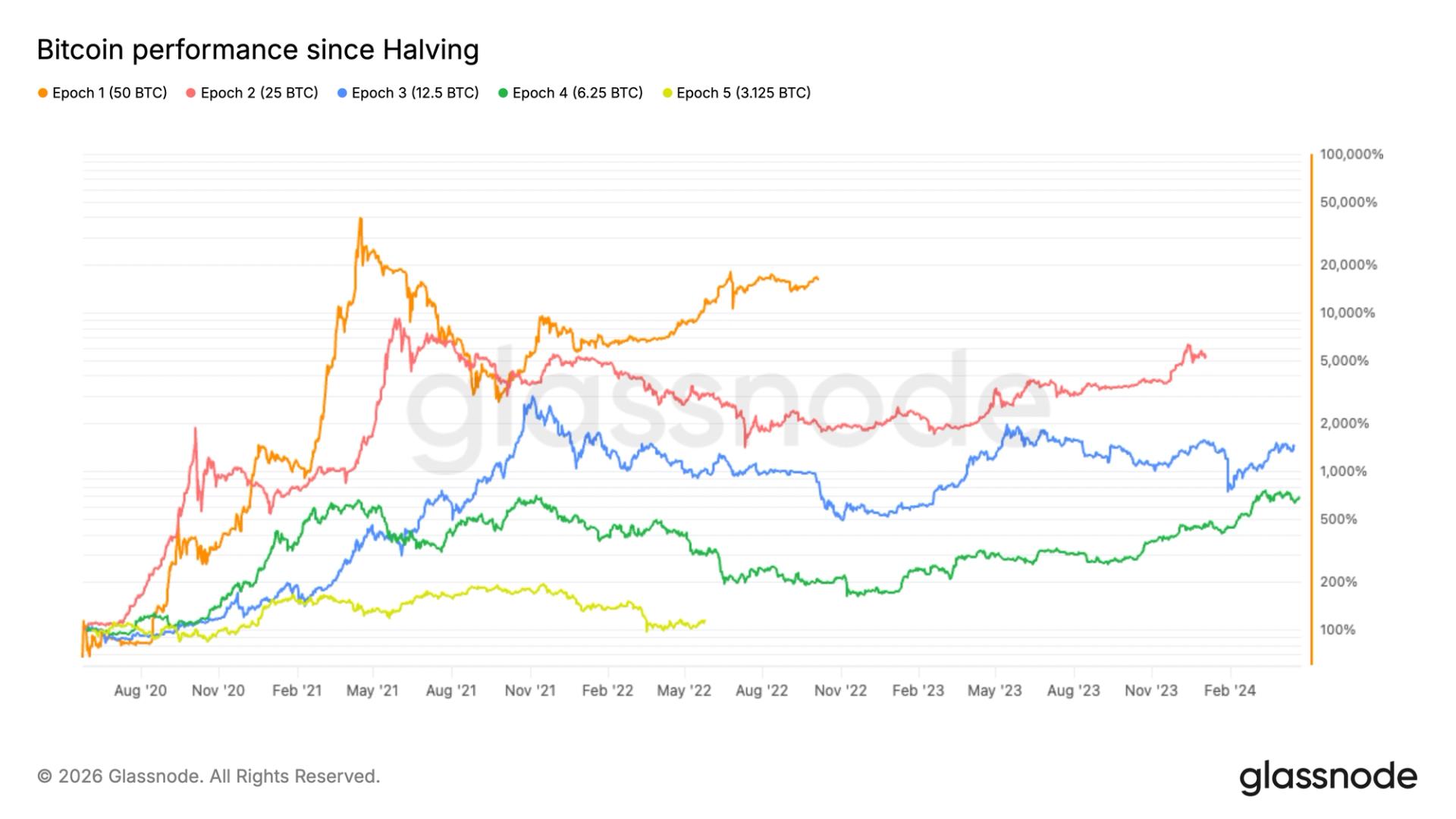
LowThe article indicates that bitcoin's price gains since the last halving are trailing previous cycles. this suggests a more mature market with diminishing returns, implying that the halving event itself might have a less pronounced immediate impact on price compared to earlier cycles.
Trustworthiness
HighPrice Direction
NeutralWhile the halving is a deflationary event, the article points to slower post-halving gains and diminishing returns as bitcoin matures. this suggests that while long-term scarcity is reinforced, immediate large price pumps directly attributable to the halving are less likely in this cycle compared to previous ones. the current price action is influenced by multiple factors, including broader market sentiment and potential liquidations mentioned in related articles.
Time Effect
LongThe halving cycle is a long-term event, and its effects on bitcoin's supply and potentially price become more pronounced over years. while immediate impacts are less dramatic, the continuous reduction in issuance over multiple cycles contributes to long-term scarcity and potential value appreciation.
Original Article:
Article Content:
Markets Share Share this article Copy link X icon X (Twitter) LinkedIn Facebook Email Bitcoin passes halfway point in halving cycle as price gains trail prior cycles Slower post-halving gains reflect bitcoin’s shift toward a more mature asset. By James Van Straten | Edited by Oliver Knight Apr 14, 2026, 12:23 p.m. Make preferred on Price Performance Since Halving (Glassnode) What to know : Bitcoin is more than 50% through its current halving cycle, with issuance at 3.125 btc per block and an inflation rate below 1% as supply trends toward its 21 million cap. Bitcoin price performance is more muted this cycle, up around 15% since the April 2024 halving, highlighting diminishing returns as adoption grows and volatility declines. The Bitcoin network is now more than halfway (50.01%) through its current halving cycle, with the next halving expected on April 12, 2028, just under two years away, according to mempool.space . This cycle, known as "epoch 5", which began in April 2024 and will continue through to 2028. A halving occurs every 210,000 blocks, roughly every four years, and reduces the reward miners receive by 50%. This process controls bitcoin’s issuance and ensures a predictable decline in its inflation rate (currently under 1%). In the current epoch, the block subsidy is 3.125 BTC per block. With blocks mined on average every 10 minutes, around 450 BTC are issued daily. This 10 minute schedule is maintained through difficulty adjustments, which occur every 2,016 blocks. The network increases or decreases mining difficulty depending on how quickly blocks are found, keeping issuance consistent. With approximately 104,986 blocks remaining in this cycle, bitcoin’s supply continues its dependable path toward its fixed cap. Each new epoch further reduces issuance and its inflation rate, reinforcing its long term scarcity. Bitcoin has a fixed maximum supply of 21,000,000 coins, one of its main characteristics which underpins its scarcity. Recently, the network reached a major milestone as the 20 millionth bitcoin was mined , meaning the final million will take another 114 years to mine. Bitcoin post-halving gains lag prior cycles Bitcoin is up around 15% since the April 2024 halving, rising from roughly $64,000 to just under $75,000. Previously reached an all time high of around $126,000 in October 2025 before falling roughly 50% to $60,000 in early February. However, it has underperformed previous cycles over the same post-halving period, continuing the trend of diminishing returns, according to Glassnode data . This is largely expected as bitcoin matures, with greater adoption and a larger market cap requiring more capital to drive outsized gains. As a result, volatility is declining each cycle and price action is becoming more gradual compared to earlier cycles. Bitcoin News Glassnode More For You Bitcoin tests $75,000 as $200 million in shorts face liquidation risk By Oliver Knight , Omkar Godbole | Edited by Sheldon Reback 1 hour ago Bitcoin price approaches $75,000 level with $200 million in shorts at risk of liquidation, rising open interest and shifting volatility dynamics in focus. What to know : Roughly $200 million in short positions could be liquidated if bitcoin crosses above $75,500, potentially accelerating a breakout. Open interest in bitcoin and ether futures has surged alongside positive funding rates and buying pressure. Implied volatility has stopped falling even as prices rise, raising questions about the sustainability of the... Read full story Latest Crypto News Bitcoin, ether in Goldilocks rally while smaller coins take a back seat 1 hour ago OneCoin victims get a $40 million lifeline more than a decade after the scam began 1 hour ago A fake Ledger app on the Apple App Store drained $9.5 million in crypto 1 hour ago Deutsche Börse takes 1.5% stake in crypto exchange Kraken for $200 million 1 hour ago Bitcoin tests $75,000 as $200 million in shorts face liquidation risk 1 hour ago Bank of Korea nominee backs central bank-led digital currency, sees limited role for stablecoins 2 hours ago Top Stories Here are key bitcoin price levels to watch as the rally gathers steam 3 hours ago Strategy's STRC sees record-breaking trading day, may surpass that on Tuesday 2 hours ago Nikita Bier says crypto has had a rough year, hints at building something new as X Money launch nears 6 hours ago Ether outpaces bitcoin as ETF flows split and Ethereum activity jumps 41% on-week 8 hours ago NFT bull Steve Aoki sells his SHIB, ETH, and PEPE. His Bored Apes are down 88%. 5 hours ago Bearish bets lose $430 million as BTC, ETH surge as much as 7% 7 hours ago