Why Michael Saylor's bitcoin buys aren’t moving the needle anymore
Analysis
Price Impact
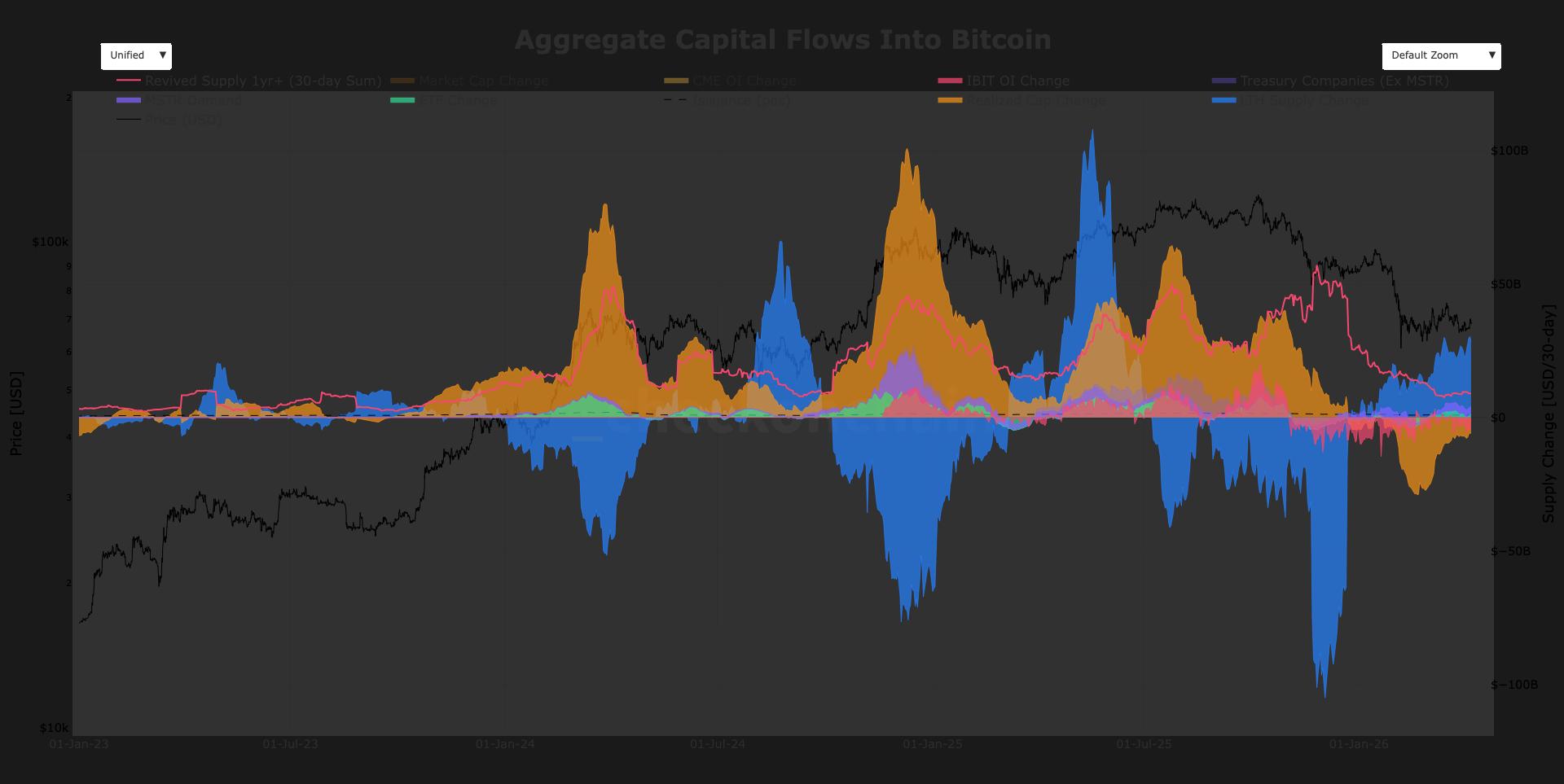
LowMicrostrategy's (mstr) recent bitcoin purchases, while substantial in absolute terms, represent only about 7% of gross inflows and 9% of net flows. this demand is significantly smaller than broader market forces like long-term holder positioning, etf inflows, and miner issuance, thus failing to move the needle on bitcoin's price.
Trustworthiness
HighPrice Direction
NeutralWhile mstr continues to buy, its impact is outweighed by larger capital outflows and supply pressures from long-term holders and miners. the net effect on price is neutral in the short term as these opposing forces balance each other out.
Time Effect
LongThe analysis highlights a trend where mstr's influence on bitcoin's price has decreased over time, particularly since its peak in late 2024. this suggests that while mstr may remain a consistent buyer, its ability to drive price action is diminishing in the long term as the market matures and other capital flows become more dominant.
Original Article:
Article Content:
Markets Share Share this article Copy link X icon X (Twitter) LinkedIn Facebook Email Why Michael Saylor's bitcoin buys aren’t moving the needle anymore Despite billions in purchases, MSTR demand is being outweighed by long term holder positioning and broader capital flows. By James Van Straten | Edited by Jamie Crawley Apr 7, 2026, 11:34 a.m. Make preferred on Aggregate Capital Flows into Bitcoin (Checkonchain) What to know : Strategy accounts for only 7% of gross inflows, meaning its buying is small relative to total market demand and easily offset by larger forces. Long-term holder positioning, revived supply, and realized cap changes are dominating flows. U.S. spot ETFs have added roughly $1 billion of inflows over the past 30 days, while miner issuance, at 450 BTC per day, contributes around $880 million of monthly supply pressure. Strategy (MSTR), the world’s largest publicly traded holder of bitcoin, announced on Monday that it purchased 4,871 BTC for $330 million, marking one of its largest acquisitions of 2026. Yet a recurring question remains, why do these sizable purchases fail to move the market? In fact, bitcoin’s price often declines around the time these announcements are made. The answer lies in understanding market flows. MSTR demand currently accounts for roughly 7% of total gross inflows, rising to about 9% of net flows, according to checkonchain data. Gross flows reflect only positive demand entering the market, while net flows account for both buying and selling, giving a clearer picture of overall pressure. While Strategy remains a consistent buyer, its impact is relatively small compared to broader market forces. Historically, its influence was larger. MSTR demand peaked above $15 billion in November 2024, coinciding with its all-time high stock price high and bitcoin over $100,000. Since then, activity has normalized to a range of $1 billion to $4 billion, with current demand around $2.8 billion over the past 30 days. The dominant force is long-term holders (LTHs), coins held for more than 155 days, which are driving roughly $28.5 billion in supply change. A key subsection is revived 1+ year supply — older coins moving on chain over the past 30 days — which represents roughly $9 billion in change. Elsewhere, U.S. spot exchange-traded funds (ETFs) have added roughly $1 billion of inflows over the past 30 days, while miner issuance, at 450 BTC per day, contributes around $880 million of monthly supply pressure. More importantly, capital continues to leave. Bitcoin's realized cap saw a $29 billion drawdown since February over a 30-day window, while BlackRock's IBIT open interest is down over $4 billion. Together, these outflows dwarf MSTR’s demand. Strategy may be buying aggressively, but it is being overwhelmed by larger forces distributing supply and capital being pulled out of the system. Bitcoin News MicroStrategy More For You Encryption Supremacy: Zcash and Privacy in the Age of Scale By CoinDesk Research Mar 31, 2026 Commissioned by GenZcash Most crypto privacy models weaken as blockchain data grows. Encryption-based models like Zcash strengthen. CoinDesk Research maps the five privacy approaches and examines the widening gap. Why it matters : As blockchain adoption scales, the metadata available to machine learning models scales with it. Obfuscation-based privacy approaches are structurally degrading as a result. This report provides a comprehensive comparison of all five major crypto privacy architectures and a framework for evaluating which models remain durable as AI capabilities improve. View Full Report More For You Bitcoin price-drop speculation spurred by familiar price pattern By Oliver Knight , Saksham Diwan | Edited by Sheldon Reback 41 minutes ago BTC and ETH remain stuck in a two-month range as oil prices and Iran tensions weigh on sentiment, while AI and privacy tokens show surprising relative strength. What to know : Bitcoin has been trapped between support at $62,000 and resistance at $75,000 since early February, a pattern that has historically preceded a price breakdown. Despite marketwide apathy, specific sectors like AI (FET, RENDER) and privacy (ZEC, DASH) are gaining, suggesting investors are rotating into niche assets rather than buying across... Read full story Latest Crypto News Bitcoin briefly touches $70,000 as ETF inflows signal institutional interest 17 minutes ago Bitcoin price-drop speculation spurred by familiar price pattern 41 minutes ago Bitcoin pulls away from software stocks as Iran war, AI reshape market dynamic 1 hour ago Bitcoin ETF inflows hit highest level since February 5 hours ago XRP slips to $1.31 after failed breakout as liquidity dries up 5 hours ago Bitcoin miners face a new rival for cheap power as Anthropic signs multi-gigawatt compute deal 6 hours ago Top Stories SEC close to putting out 'reg crypto' for fundraising questions, Chair Atkins says 7 hours ago Appeals court blocks New Jersey from shutting down Kalshi's sports markets 19 hours ago Bitcoin drops toward $68,000 as demand weakens and whales sell 7 hours ago OpenAI CEO urges U.S. to prepare for AI ‘superintelligence’ risks and gains 19 hours ago