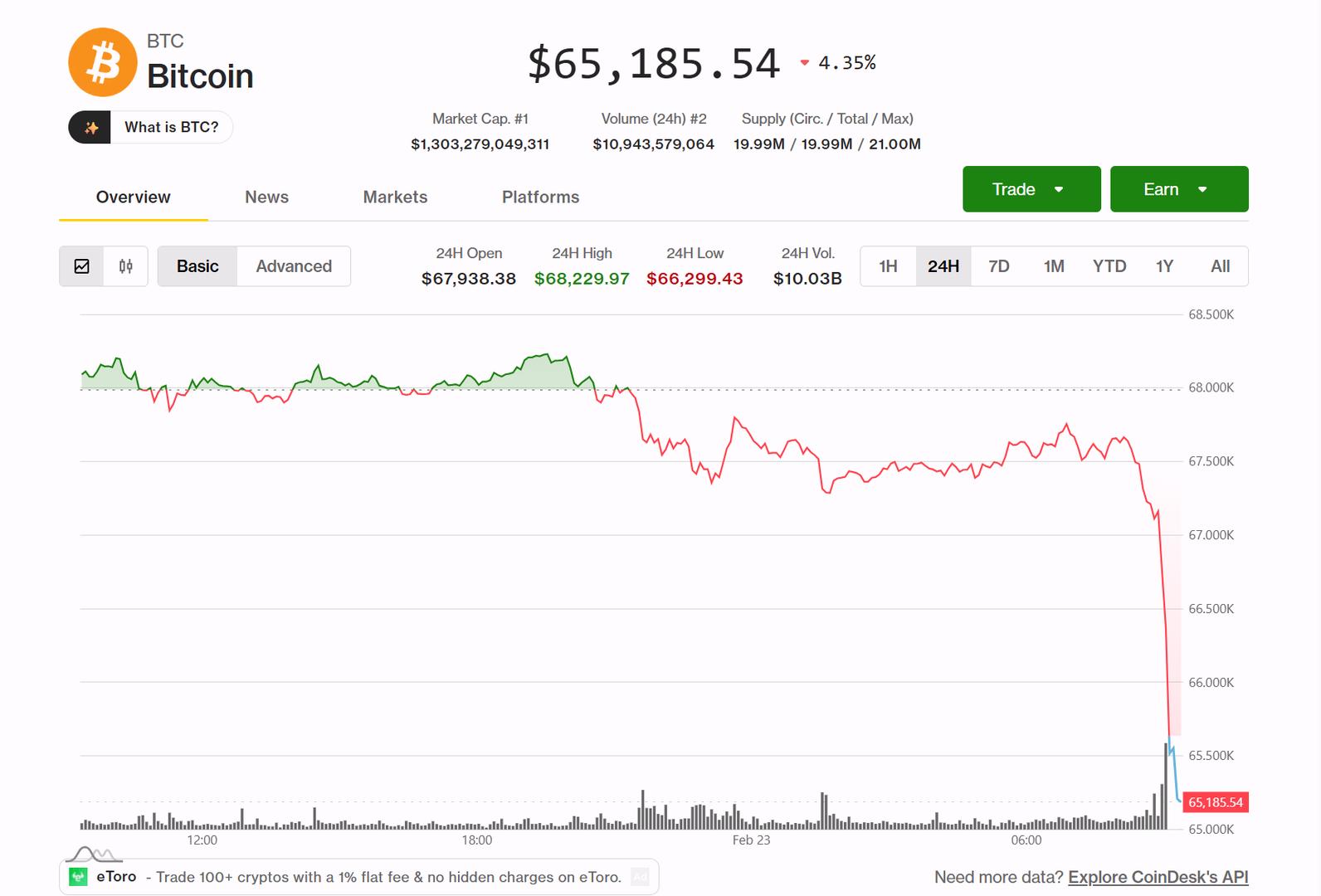
Bitcoin slides 4% to $65,000 as whale selling grows and recent buyers lock in losses
Analysis
Price Impact
HighBitcoin has experienced a significant 4% slide to $65,000, indicating strong selling pressure. the data suggests a shift from panic selling by recent buyers to selling pressure from large holders (whales), which can lead to more sustained downward movements if this trend continues.
Trustworthiness
HighThe analysis is based on on-chain data from reputable sources like glassnode and cryptoquant, which provide concrete metrics on holder behavior, exchange flows, and realized losses. the consistency between different data sets enhances its reliability.
Price Direction
BearishThe combination of increased whale selling, recent buyers locking in losses, shrinking stablecoin inflows, and rising altcoin deposits suggests a weakening demand and increasing supply on exchanges, pointing towards further downside pressure in the short term.
Time Effect
ShortThe immediate impact of whale selling and ongoing loss realization by recent buyers suggests that the bearish pressure is likely to be felt in the short term as the market digests these events and potentially enters a prolonged base-building phase.
Original Article:
Article Content:
Markets Share Share this article Copy link X icon X (Twitter) LinkedIn Facebook Email Bitcoin slides 4% to $65,000 as whale selling grows and recent buyers lock in losses On-chain data from Glassnode and CryptoQuant shows large holders dominating exchange inflows while short-term investors continue to sell at a loss, pointing to a fragile base-building phase. By Sam Reynolds , AI Boost Feb 23, 2026, 1:49 a.m. Make us preferred on Google (CoinDesk) What to know : Bitcoin has slid to about $65,000, down 4.4% after a weekend drop from the $67,000 range, as on-chain data shows the market remains under pressure. Losses realized by recent bitcoin buyers have eased from roughly $1.24 billion to $0.48 billion per day, signaling that panic selling is cooling but that a bottom-building phase may still be underway. Exchange data shows large holders now dominate selling, altcoin deposits and volatility are rising, and stablecoin inflows have shrunk, all pointing to weaker buying power as bitcoin tests support around $65,000. Bitcoin is trading around $65,000 as Asia's trading week begins, down 4.4% according to CoinDesk market data . The move follows a sharp flush from the $67,000 range, where it was trading over the weekend, and comes as on-chain data from Glassnode and CryptoQuant suggest the worst of the panic may have passed, but the broader structure remains under pressure. STORY CONTINUES BELOW Don't miss another story. Subscribe to the Crypto Daybook Americas Newsletter today . See all newsletters Sign me up By signing up, you will receive emails about CoinDesk products and you agree to our terms & conditions and privacy policy . Glassnode data shows that recent Bitcoin buyers were realizing heavy losses earlier this month. A smoothed 7-day measure of short-term holder profits and losses fell to –$1.24 billion per day on Feb. 6, meaning newer investors were collectively locking in more than $1 billion in losses each day. The 7D-EMA of Net Realized Profit & Loss for recent investors plunged to –$1.24B/day on Feb 06, before moderating to –$0.48B/day today. While the intensity has cooled, the broader regime still signals a market under pressure, with participants in the base formation phase… https://t.co/rhCsrDuDfJ pic.twitter.com/00zibdP1om — glassnode (@glassnode) February 23, 2026 That figure has since improved to about –$0.48 billion per day. In other words, panic selling has slowed but has not fully stopped. Recent buyers are still selling at a loss overall, a dynamic that typically appears during bottom-building phases rather than during strong uptrends. Exchange flow data from CryptoQuant paints a similar picture of shifting market dynamics. Data from CryptoQuant's latest weekly report shows that the amount of bitcoin being sent to exchanges surged to about 60,000 BTC per day during the early February drop toward $60,000. That figure has since fallen to roughly 23,000 BTC on a 7-day smoothed basis, suggesting the wave of immediate selling has cooled. But who is doing the selling has changed. CryptoQuant’s “exchange whale ratio” has climbed to 0.64, the highest level since 2015. That means nearly two-thirds of the bitcoin flowing onto exchanges is coming from just the 10 largest deposits each day. In other words, large holders, often referred to as whales, are accounting for most of the supply hitting exchanges. The average size of each bitcoin deposit has also risen to levels last seen in mid-2022, reinforcing the idea that bigger players, not small retail traders, are driving current exchange activity. Altcoins are facing broader distribution. CryptoQuant data shows average daily altcoin exchange deposits have risen to about 49,000 so far in 2026, up from roughly 40,000 in Q4 2025. Elevated deposit activity across alternative tokens has historically coincided with higher volatility and weaker risk appetite. Liquidity buffers are thinning as well. Net USDT inflows to exchanges have compressed sharply from a one-year high of $616 million in November to just $27 million, and briefly turned negative in late January, per CryptoQuant. Stablecoin inflows typically expand during rallies. Their contraction suggests reduced marginal buying power. Taken together, Glassnode’s loss-realization data and CryptoQuant’s exchange metrics describe a market digesting a capitulation event but not yet rebuilding strong demand. As the week beggins the key question is whether the $65,000 level holds as a near-term pivot, or whether BTC remains in a prolonged base-building phase. btc crash Bitcoin Price AI Disclaimer: Parts of this article were generated with the assistance from AI tools and reviewed by our editorial team to ensure accuracy and adherence to our standards . For more information, see CoinDesk's full AI Policy . More For You Bitcoin see-saws around $68,000, DOGE, ETH slide as tariff uncertainty weighs on risk assets By Shaurya Malwa 10 hours ago President Donald Trump raised the global tariff rate to 15% despite a Supreme Court ruling against earlier emergency trade measures, keeping pressure on China and other partners. What to know : Bitcoin fell to about $67,500, extending weekly losses as renewed trade tensions and legal uncertainty over U.S. tariffs weighed on risk assets. President Donald Trump raised the global tariff rate to 15 percent despite a Supreme Court ruling against earlier emergency trade measures, keeping pressure on China and other partners. Major cryptocurrencies, including Ether, XRP, Solana, Dogecoin, Cardano and BNB, also declined as digital assets continued to trade in line with broader macro and trade headlines. Read full story Latest Crypto News How decentralized AI is leveling the playing field 7 hours ago To freeze or not to freeze: Satoshi and the $440 billion in bitcoin threatened by quantum computing 9 hours ago Bitcoin see-saws around $68,000, DOGE, ETH slide as tariff uncertainty weighs on risk assets 10 hours ago XRP falls 4% as network sees biggest realized loss spike since 2022 10 hours ago ProShares' stablecoin-ready ETF sees $17 billion debut, sparking speculation about Circle 10 hours ago SportFi’s next act: onchain markets built around match-day results 12 hours ago Top Stories Mentioning 'bitcoin' or crypto on AI agent OpenClaw's Discord will get you banned 20 hours ago ‘Bitcoin to zero’ searches spike in the U.S., but the bottom signal is mixed Feb 21, 2026 Small investors are buying bitcoin. For a rally to succeed, the whales need to join in. Feb 21, 2026 Blue Owl liquidity crisis has investors bracing for 2008-style fallout — it could mean bitcoin's next bull run Feb 21, 2026 Ethereum's Vitalik Buterin proposes AI 'stewards' to help reinvent DAO governance Feb 21, 2026 How AI is helping retail traders exploit prediction market 'glitches' to make easy money Feb 21, 2026