Galaxy’s Steve Kurz sees ‘great convergence’ driving crypto’s long-term outlook
Analysis
Price Impact
MedWhile the long-term outlook is highly bullish due to structural shifts, kurz anticipates several months of consolidation and range-bound trading before gradual gains, not a v-shaped recovery. this suggests a moderate near-term price impact.
Trustworthiness
HighGalaxy digital is a prominent institutional player in the crypto space, and steve kurz is their global head of asset management. their analysis is based on deep industry knowledge, proprietary research ('the great convergence'), and institutional client interactions.
Price Direction
BullishGalaxy's thesis centers on 'the great convergence' – the fusion of crypto as an asset class and a core financial infrastructure with traditional finance. healthy deleveraging, accelerating stablecoin adoption, tokenization, and increasing institutional capital flow are foundational for long-term growth, despite short-term consolidation.
Time Effect
LongKurz explicitly states this is a 'multiyear structural shift,' not a short-term 'buy the dip' trade. while short-term consolidation is expected, the fundamental integration of crypto into global financial services will drive value over an extended period.
Original Article:
Article Content:
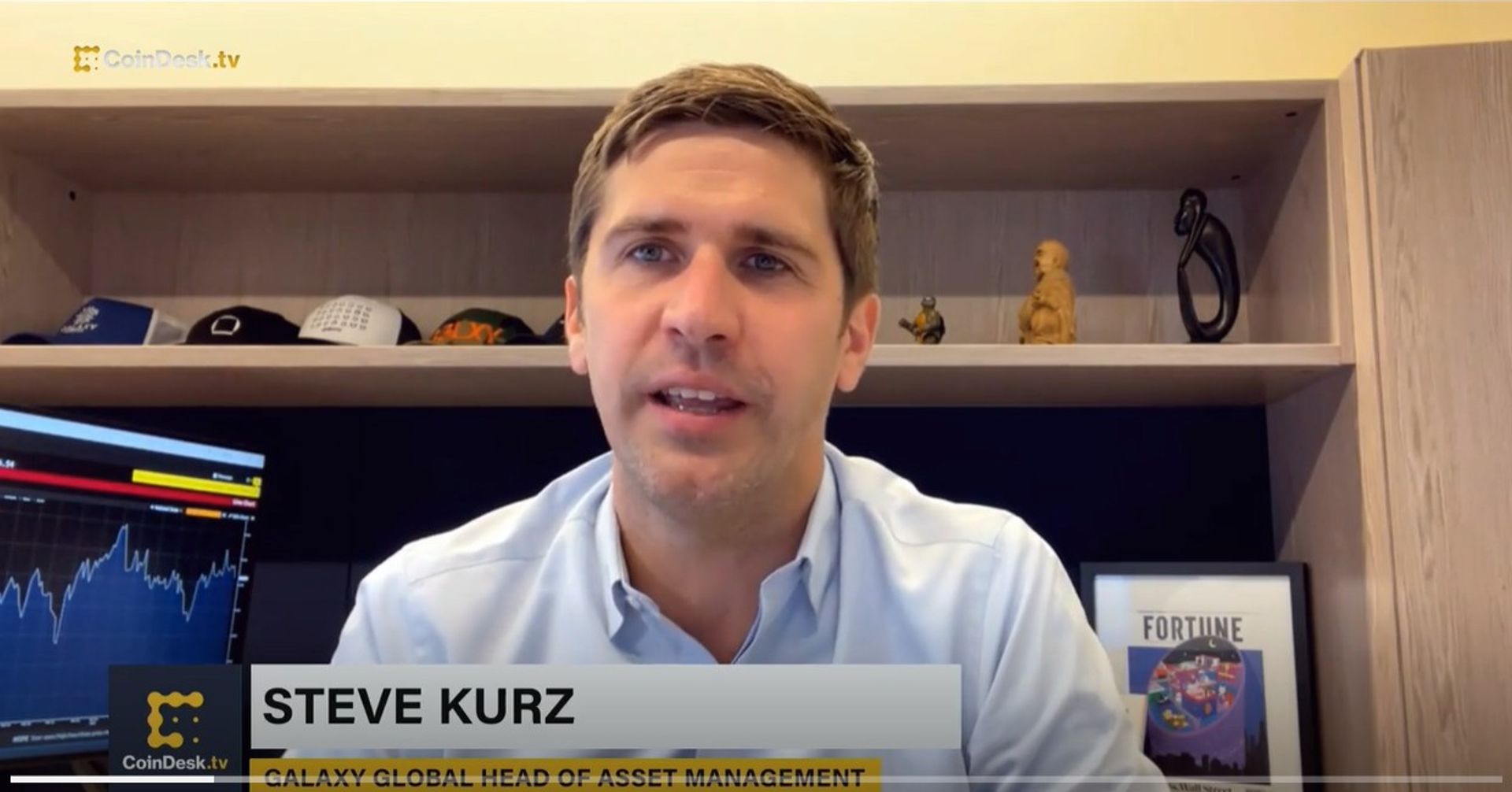
Finance Share Share this article Copy link X icon X (Twitter) LinkedIn Facebook Email Galaxy’s Steve Kurz sees ‘great convergence’ driving crypto’s long-term outlook The firm's asset-management chief says the recent crypto selloff reflects healthy deleveraging, while infrastructure growth and institutional adoption support a bullish outlook. By Will Canny , AI Boost | Edited by Sheldon Reback Feb 14, 2026, 4:00 p.m. Make us preferred on Google Steve Kurz on CoinDesk TV (Screen grab) What to know : Recent declines in crypto were driven by liquidity and leverage unwinds, not systemic failure, marking a more mature cycle than 2022, with most forced selling likely behind the market, according to Galaxy Digital's Steve Kurz. Stablecoins, tokenization and blockchain integration with traditional finance are accelerating, positioning crypto as both a financial asset and core financial rail. Kurz said he does not expect a V-shaped recovery, but sees range-bound trading followed by gradual gains as institutional capital deepens and the “great convergence” between crypto and traditional finance continues. Crypto is no longer just an asset class, it is also an ever-more critical part of financial infrastructure, says Steve Kurz, Galaxy Digital's (GLXY) global head of asset management and co-head of digital assets In “ The Great Convergence ,” the company's 2026 investment outlook, Kurz sets out a plan that’s pragmatic about what can be done now while staying optimistic about the big picture in the long run. STORY CONTINUES BELOW Don't miss another story. Subscribe to the Crypto Daybook Americas Newsletter today . See all newsletters Sign me up By signing up, you will receive emails about CoinDesk products and you agree to our terms & conditions and privacy policy . The defining story of this cycle, he argues, is the asset-to-infrastructure transformation. "The convergence of traditional financial rails with crypto infrastructure represents a significant and durable market structure evolution for global financial services," Kurz told CoinDesk in an interview. Galaxy Digital, a digital asset financial services and investment firm founded in 2018 by Michael Novogratz, functions as a bridge between traditional finance and the expanding cryptocurrency ecosystem. It offers institutional-grade trading, asset management, investment banking, custody, mining and infrastructure services and, increasingly, consumer-facing products. A market caught in overlapping cycles Kurz characterizes the current environment as one where “a lot of cycles are sitting on top of each other.” While crypto token prices have pulled back substantially, he stresses that the levels reached are now below those at which many fundamentally positive developments have occurred. That disconnect makes it “pretty hard not to scratch your head.” In his view, the dominant force behind recent price weakness has been the liquidity and leverage cycle. While the October liquidity event and subsequent deleveraging weighed heavily on markets, it differed from 2022, when liquidations exposed structural fragilities in a less developed market architecture. Today’s pullback is healthier. The ecosystem now includes more sophisticated instruments and better-developed risk-management frameworks. The selloff, he argues, was “a regular wave of deleveraging,” not a systemic breakdown in the back end of the system. Infrastructure is growing rapidly, and prices usually respond only after tangible increases in activity and adoption, rather than beforehand, he said. When onchain activity and engagement rise again, the story will coalesce around it. He allows that “there’s always a possibility of a leg down,” but said most of the dramatic selling has probably already occurred. Enough pain has been absorbed that consolidation, range-bound trading or a gradual grind higher are more likely than a V-shaped recovery. His base case is several months of consolidation followed by a firmer move into the second half. A new regime: crypto on a bigger dashboard At the center of his thesis: Crypto's integration into Wall Street’s plumbing. With new connections to traditional finance, crypto is now on a much bigger dashboard of global assets, a position that comes with trade-offs. Capital now flows across a broader opportunity set, and crypto competes more directly with established assets like gold or emerging themes such as quantum technology. The bar for attracting global capital is higher. According to Kurz, that's evidence of maturity. The relationship between crypto and traditional finance is still immature, but is deepening. Public blockchains are increasingly viewed as institutional-grade infrastructure. Stablecoins and tokenization are reshaping payments and market structure. The tentacles of crypto infrastructure are spreading across financial services. This is what he calls a bull market in crypto plumbing. The infrastructure layer — custody, compliance frameworks, integration with banks and fintechs — is clearly advancing. And while that may not immediately translate into price appreciation in the short term, it is foundationally important for the long-term value of both the technology and the assets built on top of it. The fusion of asset and technology Key to the "Great Convergence” is the fusion of crypto as an asset class with crypto as a technology stack. That integration is driving the creation of a larger, more robust onchain economy. Galaxy remains focused on crypto-native assets and believes the long-term bridge being built between infrastructure and capital markets is highly likely to play out. Kurz is clear: This is not a short-term “buy the dip” trade; it is a multiyear structural shift. Sentiment, risks, and the bottoming process Kurz notes that the spread between price, sentiment and underlying business activity has “never been wider.” While market prices have struggled, business activity, particularly on the infrastructure side, remains strong. That divergence gives Galaxy conviction. He downplays existential fears, such as quantum computing, as immediate threats to crypto’s viability. More broadly, he observes that periods of intense negativity often coincide with market bottoms. At the same time, he identifies a subtler risk: apathy. A loss of relevance in the broader market conversation would be more concerning than volatility itself. Bitcoin BTC $ 69,795.50 , in his experience, often acts as a “canary in the coal mine.” Historically, it has been adept at sniffing out macro risk moves before other markets react. It’s possible, he suggests, that BTC sensed broader risk-off conditions and absorbed the pain first. That dynamic can work in both directions. Having “lived with bitcoin enough,” Kurz believes it can be assessed through a cyclical macro lens. Crypto no longer trades in isolation; it is increasingly intertwined with broader liquidity and risk cycles. Galaxy’s performance and strategic positioning Against this backdrop, Galaxy sees strong momentum in its core businesses, particularly infrastructure and asset management. As of the end of last year, Galaxy had $12 billion in assets on its platform. On the infrastructure side, Galaxy is doing more than it was a year ago. It provides technology and payments services to banks and fintech companies, and its ability to integrate services with traditional financial institutions continues to improve. As for asset management, Galaxy is expanding its offerings, including the introduction of a fintech hedge fund designed for wealth and high-net-worth channels. The disruption of financial services market structure represents a “Fintech 2.0” moment and creates both public and private-market investment opportunities, according to Kurz. "Galaxy’s Fintech Fund will focus on the public markets winners and losers of the great convergence, while Galaxy Ventures will continue to invest in early-stage companies around the globe that are building high quality, crypto-enabled financial services businesses.” Institutional allocators, pensions, sovereign wealth funds and other asset owners often view crypto as cyclical. But many of these allocators are now making fresh capital allocation decisions. Galaxy reports winning business across banks, wealth intermediaries and institutional asset owners, facilitating inward capital flows even during a consolidation phase. Institutional assets under management (AUM) remains a key focus, and the firm is seeing growing engagement from large clients. The gap between subdued prices and steady institutional interest reinforces Galaxy’s long-term thesis. Owning the great convergence Ultimately, Kurz frames Galaxy’s strategy as “owning the whole story of the great convergence,” from crypto rails and onchain infrastructure all the way to public markets and asset management. The firm is positioning itself across the stack, capturing both the technological integration of crypto into traditional finance and the financialization of crypto assets. For 2026, the outlook is measured, constructive. Don’t expect a V-shaped recovery. Expect consolidation, maturation, continued infrastructure buildout. Expect crypto to compete on a broader stage for global capital. And expect the narrative to catch up to the activity once it turns. In Kurz’s view, the plumbing is being laid for a larger, more durable onchain economy. Prices may lag in the near term, but the long-term fusion of asset and technology leaves him structurally bullish on digital assets, and confident in Galaxy’s role at the center of that convergence. Read more: Deutsche Bank says bitcoin’s selloff signals a loss of conviction, not a broken market Galaxy Digital Stablecoins Tokenization Exclusive AI Disclaimer: Parts of this article were generated with the assistance from AI tools and reviewed by our editorial team to ensure accuracy and adherence to our standards . For more information, see CoinDesk's full AI Policy . More For You Accelerating Convergence Between Traditional and On-Chain Finance in 2026? By CoinDesk Jan 30, 2026 Commissioned by Societe Generale-FORGE Read full story More For You Recapping Consensus Hong Kong By Nikhilesh De | Edited by Sheldon Reback Feb 13, 2026 Crypto's role in payments for AI, regulatory changes and the digital asset market dominated conversations on the ground. What to know : Speakers at CoinDesk's Consensus Hong Kong conference said crypto and stablecoins are likely to become the default payment tools for autonomous AI agents in an emerging "machine economy." Market participants warned that bitcoin, which has already dropped nearly $30,000 in a month, may fall further, with $50,000 seen as the level to watch. Hong Kong regulators are pressing ahead with crypto rules even as others wait to see how U.S. legislation develops. Read full story Latest Crypto News Bitcoin claws back to $70,000 on cooling inflation after $8.7 billion wipeout 3 hours ago Trump-linked Truth Social seeks SEC approval for two crypto ETFs 19 hours ago Crypto group counters Wall Street bankers with its own stablecoin principles for bill 20 hours ago Wall Street analysts slash Coinbase price targets after Q4 miss — but shares rally 23 hours ago U.S.-based DeFi group urges UK FCA to anchor crypto rules to 'unilateral control' Feb 13, 2026 Ethereum Foundation leadership shake-up: Tomasz Stańczak out as co-executive director Feb 13, 2026 Top Stories Recapping Consensus Hong Kong Feb 13, 2026 Crypto market wobbles as investors ignore good news, look for ‘exit ramp’ Feb 13, 2026 Bitcoin’s long-term rally is ‘broken’ until it reclaims $85,000, Deribit executive says Feb 13, 2026 PGI Global CEO handed 20-year sentence for $200 million bitcoin, forex Ponzi scheme Feb 13, 2026 Ark Invest buys $18 million of crypto stocks including 10th consecutive Bullish purchase Feb 13, 2026 Bitcoin, ether little changed before U.S. inflation report Feb 13, 2026 In this article BTC BTC $ 69,795.50 ◢ 1.64 %