Bitcoin miners chase AI demand as Nvidia says Rubin is already in production
Analysis
Price Impact
MedBitcoin miners diversifying into ai infrastructure could stabilize their revenue, reducing selling pressure during market downturns and enhancing the network's long-term resilience. however, increased competition for data center space and energy may raise operational costs for some pure-play miners.
Trustworthiness
HighThe news comes from coindesk, a reputable crypto news source, quoting nvidia's ceo on a significant technological advancement and its implications for bitcoin miners, indicating a well-researched and credible report.
Price Direction
NeutralWhile a more resilient mining ecosystem provides long-term fundamental support for bitcoin, the immediate direct price impact of miners diversifying into ai is likely neutral. it's a strategic shift for miners, not a direct demand driver for btc in the short term.
Time Effect
LongThe strategic pivot of bitcoin miners towards ai infrastructure is a long-term business model adjustment that will impact their profitability and the overall stability of the bitcoin network over years, rather than weeks or months.
Original Article:
Article Content:
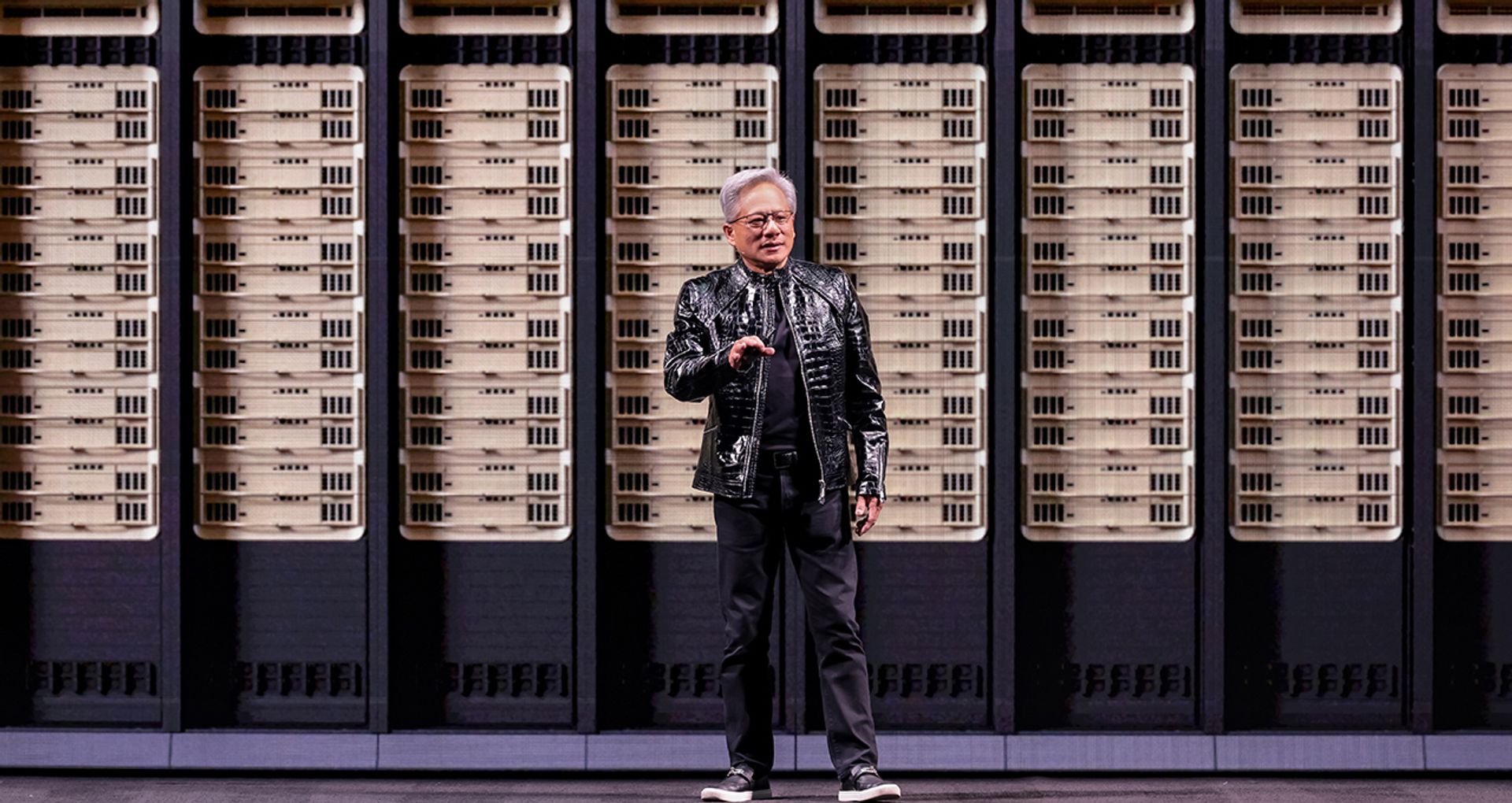
Markets Share Share this article Copy link X icon X (Twitter) LinkedIn Facebook Email Bitcoin miners chase AI demand as Nvidia says Rubin is already in production Miners that look like infrastructure companies may win, while those that rely on pure mining margins face a tougher 2026. By Shaurya Malwa | Edited by Sam Reynolds Updated Jan 7, 2026, 5:32 a.m. Published Jan 7, 2026, 5:27 a.m. Make us preferred on Google (Nvidia CEO Jensen Huang speaks at CES 2026 in Las Vegas/Nvidia) What to know : Nvidia CEO Jensen Huang announced the Vera Rubin platform, which promises five times the AI computing power of previous systems, is now in full production. The Rubin platform will feature 72 GPUs and 36 CPUs per server, with the ability to scale into larger systems containing over 1,000 chips. The AI boom is reshaping the crypto market, with bitcoin miners pivoting to offer infrastructure services to AI customers, impacting data-center space and costs. Nvidia CEO Jensen Huang said the company’s next-generation Vera Rubin platform is already in “full production,” unveiling fresh details at CES in Las Vegas about hardware that he says can deliver five times the artificial-intelligence computing of Nvidia’s previous systems. Rubin is expected to arrive later this year and is aimed squarely at the fastest-growing part of the AI business, helping to deliver outputs from trained models. STORY CONTINUES BELOW Don't miss another story. Subscribe to the Crypto Daybook Americas Newsletter today . See all newsletters Sign me up By signing up, you will receive emails about CoinDesk products and you agree to our terms of use and privacy policy . Huang said Rubin’s flagship server will include 72 of Nvidia’s graphics processing units and 36 central processors, and can be linked into larger “pods” containing more than 1,000 Rubin chips. Much of the talk was about efficiency. Huang said Rubin systems could improve the efficiency of generating AI “tokens” — the basic units produced by language models — by roughly 10 times, helped by a proprietary type of data the company wants the broader industry to adopt. He added that the performance jump comes despite only a 1.6-times increase in transistor count. Huang described AI development as a race where faster processing means reaching the next milestone sooner, forcing competitors to spend aggressively on chips, networking and storage. How bitcoin miners are impacted That same infrastructure race has been reshaping parts of the crypto market too. Bitcoin miners have increasingly marketed themselves as power-and-rackspace operators rather than pure crypto plays, pitching their energy contracts, cooling capacity and data-center footprints to AI customers. Hosting AI workloads can generate steadier cash flows than bitcoin mining during down cycles, especially for firms with cheap power, existing sites and cooling capacity. But the AI boom also raises the bar. Data-center space is becoming a premium asset, and the best sites get bid up by hyperscalers, cloud firms and AI startups. That can lift rents, equipment costs and financing hurdles for smaller miners. In other words, miners that look like infrastructure companies may win, while those that rely on pure mining margins face a tougher 2026. Meanwhile, Nvidia also highlighted new networking switches using a connection method called co-packaged optics, a key technology for linking thousands of machines into a single system. The company said CoreWeave will be among the first to receive Rubin systems, and expects Microsoft, Oracle, Amazon and Alphabet to adopt them as well. Nvidia Bitcoin Mining Artificial Intelligence Mehr für Sie KuCoin Hits Record Market Share as 2025 Volumes Outpace Crypto Market Von CoinDesk Research 22. Dez. 2025 Commissioned by KuCoin KuCoin captured a record share of centralised exchange volume in 2025, with more than $1.25tn traded as its volumes grew faster than the wider crypto market. Was Sie wissen sollten : KuCoin recorded over $1.25 trillion in total trading volume in 2025 , equivalent to an average of roughly $114 billion per month , marking its strongest year on record. This performance translated into an all-time high share of centralised exchange volume , as KuCoin’s activity expanded faster than aggregate CEX volumes , which slowed during periods of lower market volatility. Spot and derivatives volumes were evenly split , each exceeding $500 billion for the year, signalling broad-based usage rather than reliance on a single product line. Altcoins accounted for the majority of trading activity , reinforcing KuCoin’s role as a primary liquidity venue beyond BTC and ETH at a time when majors saw more muted turnover. Even as overall crypto volumes softened mid-year, KuCoin maintained elevated baseline activity , indicating structurally higher user engagement rather than short-lived volume spikes. View Full Report More For You XRP could outperform bitcoin as XRP/BTC chart shows rare Ichimoku breakout since 2018 By Shaurya Malwa , CD Analytics 49 minutes ago Traders are watching if XRP can reclaim the $2.31-$2.32 range or remain in a descending channel. What to know : XRP fell from $2.39 to $2.27, breaking below the $2.32 support level. A high-volume drop to $2.21 was absorbed by demand, stabilizing the price. Traders are watching if XRP can reclaim the $2.31-$2.32 range or remain in a descending channel. Read full story Latest Crypto News XRP could outperform bitcoin as XRP/BTC chart shows rare Ichimoku breakout since 2018 49 minutes ago Asia Morning Briefing: Bitcoin holds steady above $90K as fresh money returns to crypto 3 hours ago DeFi, ethics disputes remain in Senate crypto bill ahead of Jan. 15 vote 4 hours ago Michael Saylor's Strategy catches a break from MSCI, but analysts caution fight isn’t over yet 6 hours ago Strategy surges 6% on MSCI decision not to exclude DATs from indexes 8 hours ago Asset manager Bitwise sees 3 tests for crypto’s 2026 rally 9 hours ago Top Stories Asia Morning Briefing: Bitcoin holds steady above $90K as fresh money returns to crypto 3 hours ago Strategy surges 6% on MSCI decision not to exclude DATs from indexes 8 hours ago DeFi, ethics disputes remain in Senate crypto bill ahead of Jan. 15 vote 4 hours ago How to stay safe after the Ledger customer data leak: experts urge privacy first 9 hours ago Don’t hold your breath for Venezuela’s bitcoin 12 hours ago Crypto prices retreat in return to downward U.S. trading day action 12 hours ago